A satellite project of labs.iximiuz.com - an indie learning platform to master Linux, Containers, and Kubernetes the hands-on way 🚀
Ivan on the Server Side
|
Hello 👋 November is over, so it's time for my monthly roundup of all things Server Side. However, the format of this issue will be somewhat unusual - instead of sharing the labs update and a bunch of good reads, I'll try to cover several important topics that have come up in the past few weeks and then briefly touch on my plans for 2026. And in December, the traditional roundup will return - I've got so many great links in my stash for it 😻 In this issue:
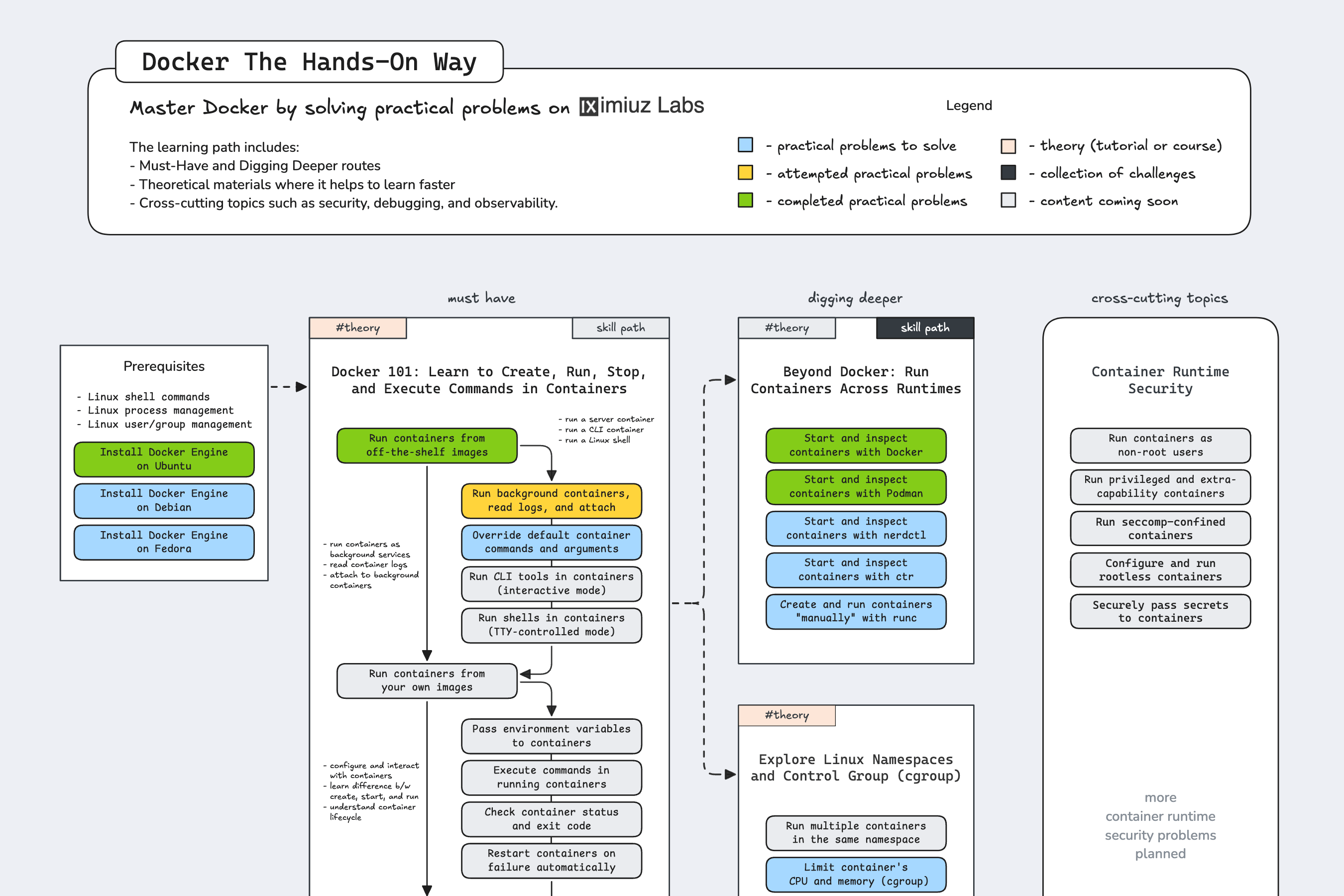
Before we dive in, here's one last reminder: the Black Friday/Cyber Monday sale ends in less than 24 hours. I won't mention it anymore for the next 6 months at least, I promise 😇 Where should I start with iximiuz Labs as a Linux/DevOps beginner?I've answered this question a lot in private DMs lately, so I figured I should write down my refined recipe and share it with you all. At the moment, for a Linux/DevOps beginner, the best place to start is the hands-on Docker roadmap. I recommend trying to solve challenges there, starting from the top, and always following the links to the theoretical materials that most challenges include. And of course, don't forget to check the Solution tab if you get stuck or even if you've solved the challenge - there might be an alternative or simpler way, and the editorial solution may shed some extra light on what’s going on under the hood.
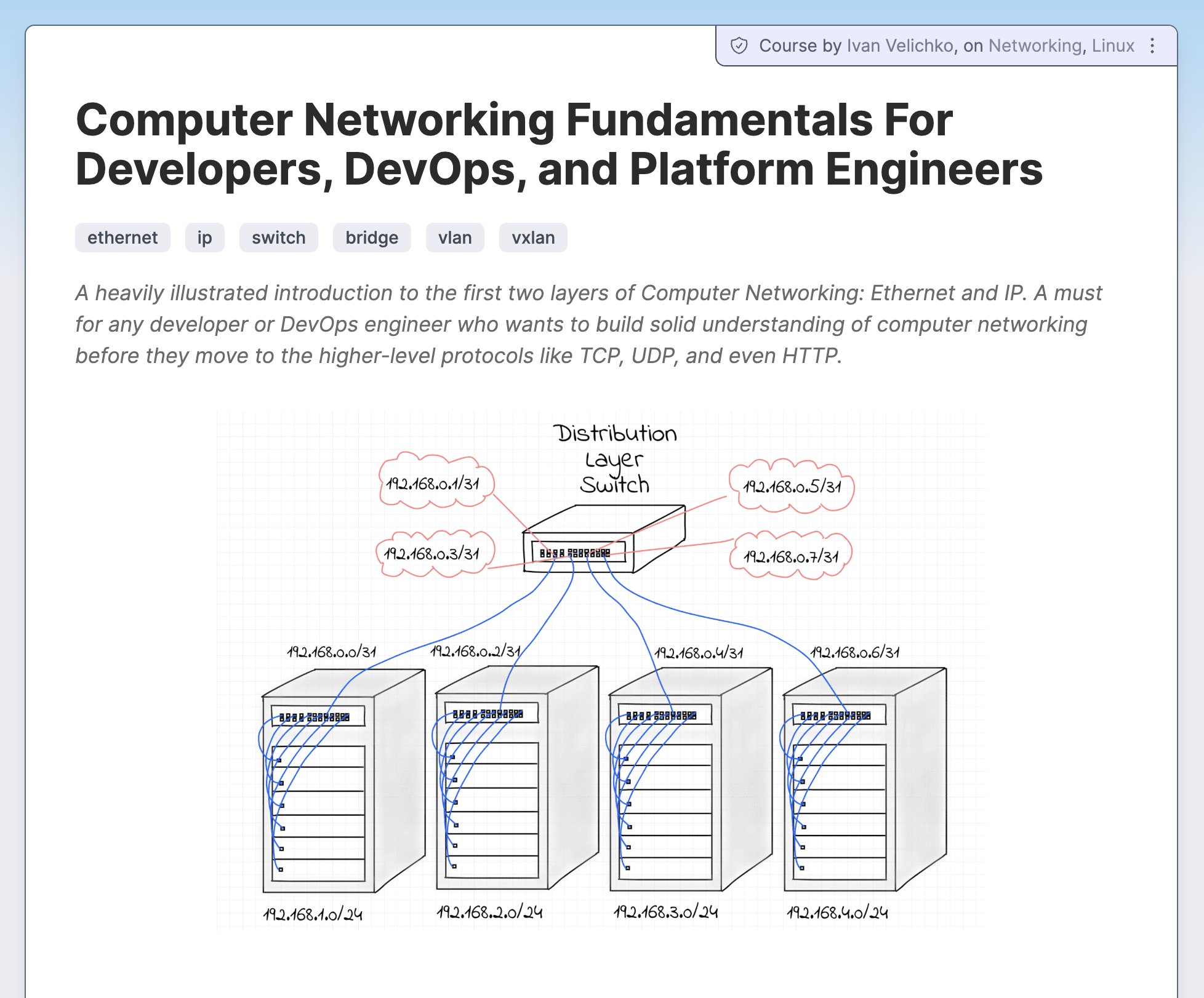
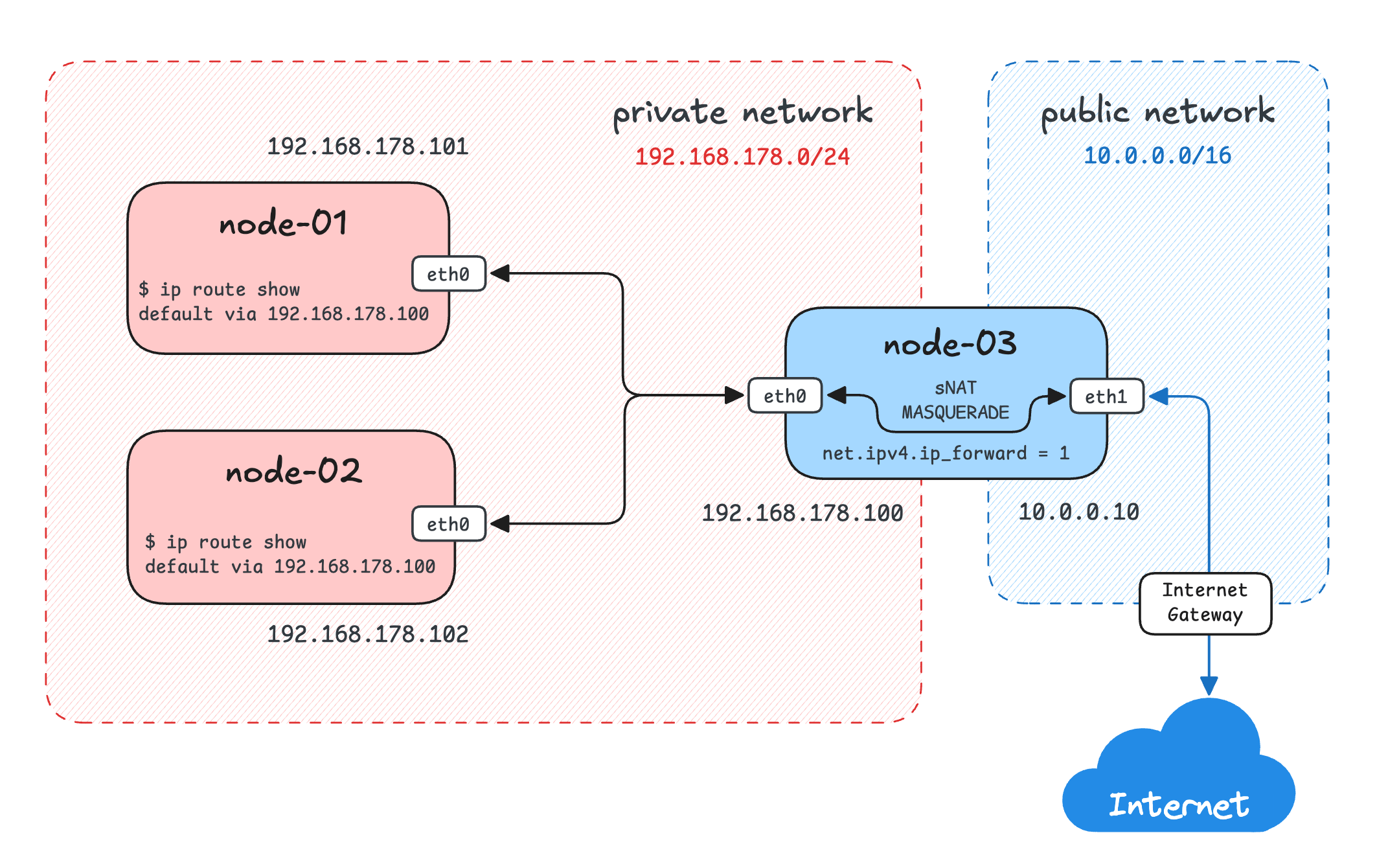
Another beginner-friendly piece is the L2 Networking Fundamentals course, augmented by these L3 challenges:
The above networking materials can be taken before, after, or in parallel with the Docker roadmap.
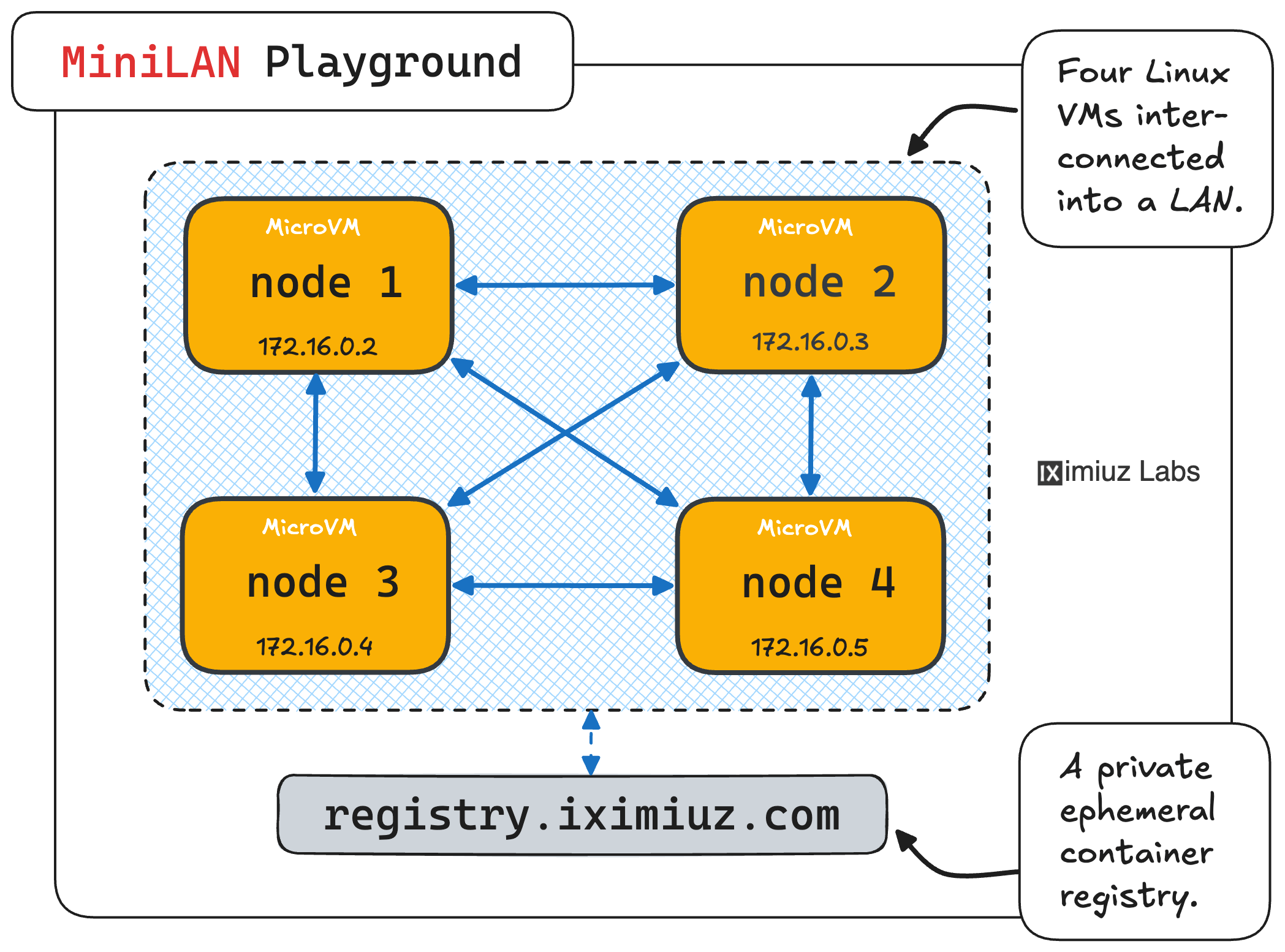
After getting through a couple of dozen Docker challenges and studying the networking fundamentals materials, it's a great time to take the Container Networking from Scratch tutorial. The applicability of the knowledge you'll get from it is much broader than just Docker bridge networks - it's the foundation everyone needs before approaching the more complex Kubernetes networking model, and it'll also come in handy while learning other virtualization tech (e.g., Firecracker, QEMU, VirtualBox VMs, Lima, Kata Containers, etc.). While going through the above materials, you'll get to solve many practical Linux problems. Some in the form of complementary challenges, some as subtasks of Docker or networking challenges. In any case, you'll become much more fluent and confident in using the terminal and operating servers. Finally, I want to emphasise that iximiuz Labs is not a single course but a holistic learning and experimentation platform. One of the key features of iximiuz Labs is its Playgrounds. In essence, they are remote, preconfigured Linux VMs that are ideal for practicing Linux, networking, Docker, or Kubernetes in a safe, controlled environment. Most of the platform's learning materials embed a playground on the side to help you practice what you've just read, but you can (and should) use standalone playgrounds for your learning tasks, too.
A typical example: while studying system design, you may want to explore the traditional 3-tier architecture of web applications, and the best way to do it is to actually deploy an API server, a database, and a client app with your own hands, as in this excellent example by Adam Leskis 🎬 Can iximiuz Labs help me become a better Cloud Engineer?There are indeed no Cloud-oriented posts on iximiuz Labs at the moment. However, it's not due to a lack of experience or resources. It is a deliberate choice, based on the following realisation. A learning sequence that has traditionally led to the most solid understanding and the most transferable knowledge is: Linux → Networking → Containers → {Kubernetes, Cloud} Jumping straight into learning the higher-level networking components, such as AWS VPC, Security Groups, Internet Gateways, and the like, is not uncommon, but in my experience, it often results in longer mastering time and the need to "re-learn" from scratch after switching from AWS to Azure or trading the expensive comfort of the cloud for a cheaper but more brutal reality of an on-prem deployment. In contrast, when you first learn about LANs (L2 broadcast domains, typical switch topologies, etc.), then L3 routing, iptables, and NAT, understanding what VPC and Security Group actually are becomes much easier.
One more great thing about this approach is that focusing on fundamentals makes the knowledge transferable sideways, too. For instance, container networking (Docker's typical bridge network) and Kubernetes' Node and Pod networking rely on the same concepts I mentioned above (L2 broadcast domains, L3 routing, iptables), even if some of the primitives will be virtualized (e.g., a Linux bridge is a virtual switch and a network namespace is an analog of an isolated network node). This is why at iximiuz Labs, we focus on the fundamentals of the server-side tech and avoid covering topics like "5 ways to configure AWS NAT Gateway in 2025" 🤦♂️ On my 2026 plans for iximiuz Labs 🚀With the recent release of Persistent Playgrounds, the platform's "engine" has become feature-complete, and my focus will finally shift toward content and a better student and author experience. Here is the list of the next "big things" for me to build:
Compared to Persistent Playgrounds, the above features are rather simple and incremental, and I expect most of the work to be done by January. After that, I'll start focusing on the main thing for 2026: growing the content collection 🚀 Here is what I intend to pull off in the next 6-12 months:
These are rather ambitious goals, but with the ever-growing level of support from the iximiuz Labs community, I'm more than certain we'll succeed 💪 Thoughts on iximiuz Labs pricing in 2026I've kept bringing up the redesign of the access plans since August, but until recently, there was very little certainty. Now I'm ready to reveal the details. The current Premium plan is very hard to price adequately due to its all-inclusive nature and potentially indefinite duration. So the idea is to split it into two finer-grained plans to serve both major audiences of the platform:
The cheaper Tinkerer plan will give access to all paid playground features (longer sessions, bigger VMs, persistence, etc.), but it won't include any learning materials. The target audience for this plan is people using the playgrounds for self-study, experimentation, and/or research, which accounts for more than 30% of contemporary playground use:
The more expensive Learner plan will include everything in the Tinkerer plan, plus full access to the official content collection (official means published by the iximiuz Labs team, which is just me at the moment, but I'm hoping to grow it). The lifetime option will likely go away, and the new Tinkerer and Learner plans will have only the monthly and yearly variants 🙈 At the same time, you can start with the Learner plan and switch to the cheaper Tinkerer plan once you've completed the active learning phase and want to continue practicing in the playgrounds at a significantly lower monthly (or early) price. On top of that, I'm going to introduce the ability to pay for individual Courses, Skill Paths, and Roadmaps so that other independent authors can monetize their materials published on iximiuz Labs (for a tiny fee). The goal I'm chasing with this redesign is two-fold:
I'd love to keep things as simple as they are now with a single Premium plan, but it's time for iximiuz Labs to adopt a more mature pricing model that reflects the ever-increasing value and enables other great authors to publish on the platform and get paid. Quality content creation is a lot of hard work, and it should be rewarded accordingly. Of course, some things must never change:
As always, feedback is much appreciated 🙏 Happy learning! Ivan |

Ivan on the Server Side
A satellite project of labs.iximiuz.com - an indie learning platform to master Linux, Containers, and Kubernetes the hands-on way 🚀